


Kombucha 101
 I realize that many people have never heard of kombucha, I certainly hadn't until I spent a couple of weeks in Denver (where the local Whole Foods carried 5 brands of it) awhile back. It originated in China and can best be described as a slightly sweetened tea that is soured by a jelly fish like cluster of microbes.
Kombucha appeals to me because it is much faster and easier to make than funky beers, in addition it has almost no sugar and less than .5% abv, so I can feel good drinking it whenever I want. I grew my culture (left) from a bottle of what I felt to be the best kombucha I had in Denver (Tea Chi), but there are commercially available cultures that require less work if you are so inclined or if you can't get a bottle locally.
The finished product can vary greatly depending on your culture. Some are clean and sharply acidic, but it should come as no surprise that my favorite brand had plenty of funk (in particular our old friend Brettanomyces). The tea doesn't have too much impact on the finished drink, it serves primarily as a nutrient source for the culture (and as such it can't be left out in favor of other flavorings).
Here is my basic recipe:
Take it off the heat and soak 2 tea bags or 2 tsp of the tea of your choice for 15 minutes (the longer brew time extracts more nitrogen and nutrients),
Dissolve 2.5 oz of white sugar into the tea
Cool to 70 degrees
Pitch your culture and about 10% of the previous batch to lower the acidity.
The culture needs oxygen, so just put a paper towel over your container and hold it in place with a rubber band.
After two weeks of fermenting in the high 60's the kombucha is ready to bottle
I generally put it into old plastic soda bottles with a 1/2 tsp of sugar, screw the cap on and wait for the bottle to feel pressurized (normally about 4 days)
At that point I put the bottles into the fridge and they are ready to go
Sanitation is not as important as it is with beer fermentation because with kombucha not only do you already have multiple microbes working together in the culture but also it is open to the air so some microbes are going to get in there regardless of your sanitation.
The next step in my process is to build up a big enough mother culture so that I can start splitting off daughter cultures to begin playing with. In particular I hope to find out if the culture is able to do its thing in the presence of hops...




 Posts
Posts


16 comments:
I may have just overlooked this, but where did you get the culture?
Heard of this on Basic Brewing - fyi - sounds like a good thing as my wife goes nuts for the stuff.
I was glad to learn of your brewing technique! I've recently gotten into brewing myself and was wondering if you know anything about the legalities of selling your own kombucha brew.
I am no legal expert, but I would imagine that selling Kombucha would be much easier than selling beer/wine, provided that your alcohol stays below .5% (and it is thus technically non-alcoholic). I would try to find a local Kombucha producer and ask them what laws are applicable. If there isn’t one I assume similar laws would apply to trying to sell any non-alcoholic beverage, so try talking to a small producer of soda, ice tea, or fruit juice.
Best of luck, every time I go into my local Whole Foods there seems to be a new Kombucha, certainly seems like a growing industry.
Hi. I was wondering if you tried to brew kombucha with hops? Don't hops have antibacterial properties? I'm wondering if that would damage the SCOBY?
I recently got an email about using hops in kombucha, I had similar thoughts about the anti-microbial properties. Here was my response:
Haven't tried it.
Two thoughts:
1st are you thinking of boiling the hops to get some bitterness, or just steeping some for aroma? Generally sourness and bitterness don't blend too well, so I would probably avoid that, but some hop aroma could do very nicely.
Hops were originally added to beer to fend off bacteria (or at least slow it down). I would bet that if you added the hops before fermentation it would effect the ratio of the various microbes. Maybe try adding a few cones to each bottle at bottling, that should give you some aroma and keep the hops from effecting your culture.
Sounds like an interesting idea, if you give hoppy kombucha a try please let me know how it turns out.
Hey Mike! Quick question(s) for ya. A quick history... I've been brewing beer for 8+ years now. I had a brief forray into brewing kombucha a year or so back. I grew a scoby from a bottle of gt's, made some small quart batches, then stepped up to gallon brews but for some reason stopped before harvesting my first gallon brew. I've been reading your blog quite a bit as I'm about to start brewing sour beers and stumbled upon your kombucha posts. With what your doing with the malt kombuchas, and my recent interest in sour beers, it re-ignited my interest in brewing kombucha.
That being said, I had a gallon batch of kombucha going that i just kind of...forgot about in one of my cupboards :) Here's a pic.
http://img59.imageshack.us/img59/6249/img2817cq.jpg
You can see the daughter has outgrown the mother by quite a bit :)
http://img30.imageshack.us/img30/3100/img2822uq.jpg
The scoby was very firm and appears healthy. The only reason it is damaged is because it was so thick and awesome that i struggled to get it out of the jar and had to kinda mush it a bit!
Smell is kombucha-ey, more towards the vinegar side of things. No offensive or off smells present. A quick dip and taste of the liquid is very sour and again almost but not quite vinegar.
My question is whether you think it would be OK to use this mother/daughter? I brewed up some tea, pulled out the scoby, and separated the daughter from the original mother. I tossed the original ma in some fresh tea with a bit of the old tea and cut a chunk of the giant daughter off and tossed it in some fresh tea w/ a bit of the old as well.
http://img243.imageshack.us/img243/281/img2824k.jpg
Do you think I still have a good ratio of critters or will the long aging of this scoby cause her to just make vinegar?
I'm no kombucha expert (I had the same issue as you, I just stopped doing it after a few months), but I'd worry that after all that time the yeast will be dead and you'll be left with just acetobacter. Luckily the test is cheap, just wait and give it a taste to see how it turns out.
Those are some really gnarly scobies. Good luck!
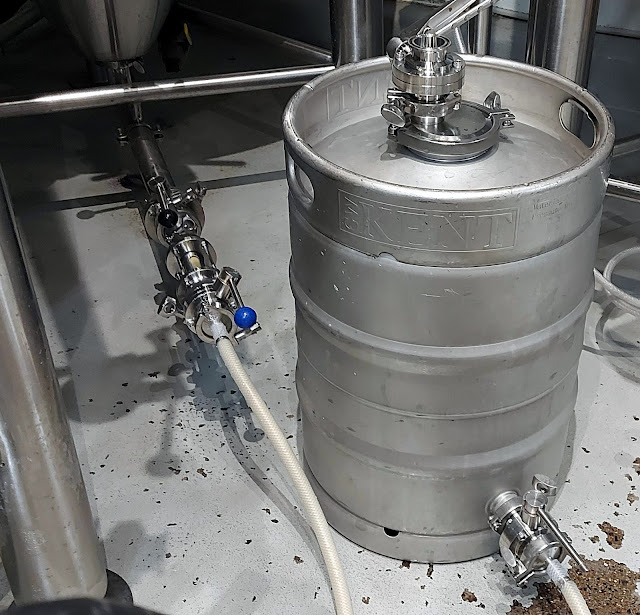
Am doing some internet research and found your site. So interesting! I am looking to brew kombucha on a larger scale (5 gallon kegs), but I can't seem to figure out whether or not these kegs would need to be refrigerated after the kombucha has been carbonated. Any advice or resources that could point me in the right direction with my project?
I know a lot of producers have run into issues with excess alcohol production if their bottles are not refrigerated. With oxygen available the microbes will produce acetic acid, but in the absence of oxygen they will produce ethanol. If you aren't sterile filtering or pasteurizing the kombucha, and there is still some residual sugar, warm storage could be a risk. You might also generate excess carbonation, although in a keg that could be easily vented. Hope that helps, best of luck!
Hi there, I am having some issues with my kombucha after brewing for over a year. My kombucha is very fizzy, but it is still sweet. I have the feeling this means there are more bacteria than yeast, creating CO2 with no yeast to eat the sugar. Any thought or suggestions???
Alcoholic fermentation produces both ethanol and CO2 simultaneously. It can't produce one of the other. Maybe you aren't allowing it to ferment long enough before bottling and chilling? It takes only .3% ABV production to fully carbonate post-bottling. Have you taken any gravity readings?
Hi Mike, thanks for your response. I haven't done any gravity readings - how would I go about doing that? I suppose the quick solution is just to let this next batch go a little longer - at the risk of having an extremely fizzy primary ferment, which is okay.
You'd have to get a hydrometer. They are weighted to float in a sample of liquid to give a density reading of the liquid. Good luck!
I just opened a bottle that I ended up leaving to ferment (secondary) longer than the rest. It's no longer too sweet, but it has zero vinegar taste. So strange. I think I may just have to get a new culture and start again! Very weird...
Good results with Live Soda and Bearded Buch as starters. I sampled half of each and then used them in a 4L batch. Now I've bottled my first batch after 10 days. My setup is a 1 gallon Polypin with a paper towel stuffed down the spigot.
I'm interested in trying to control carbonation in the bottle a bit more. It might work to let the batch ferment out entirely and then blend in part of the next batch before bottling to obtain the right amount of fermentables to bottle condition.
Great tutorial!
Both of the commercial bottles were chosen for the large amount of sediment at the bottom and now there's a large, square mother in the Polypin.
Post a Comment